
Lackawanna Projected and Actual Release
A projected date estimates when a release may occur under the sentence and facts then known. A minimum sentence date generally marks the first point when ordinary parole can be considered. It does not require a grant. A Pennsylvania Parole Board action can authorize parole, yet a detainer, home-plan issue, later decision, or processing step may still prevent physical release on that day.
Pretrial custody is different. A person awaiting trial at Lackawanna County Prison has no sentence-based projected date. Release depends on bail, a signed bond, a court order, charge action, and any other hold. Lackawanna's local rule permits designated prison officers to accept some bail after ordinary court-office hours, but it sets no standard release hour and physical processing must still occur.
A county-sentenced person may serve a term at Lackawanna County Prison. A state-sentenced person falls under PA DOC calculation and Parole Board rules. Never apply a state release formula to a county pretrial case or read movement into another facility as community release.
Find a Lackawanna Release Date
Begin with the last known custodian and every sentencing docket tied to the custody period. The Pennsylvania UJS Case Information portal can show bail, sentence terms, later orders, and related case events. The agency computation, Board Action, and final discharge record answer different parts of the timeline.
- Decide whether the person is pretrial, county-sentenced, state-sentenced, or already on parole.
- Review both Lackawanna Magisterial District Judge and Common Pleas dockets for bail, sentencing, time credit, and amended orders.
- For county custody, ask Lackawanna County Prison for the proper records channel and request an existing commitment or discharge entry.
- For state custody, search the PA DOC locator and request the existing sentence-status or time-computation record when an official calculation is needed.
- Check Board Action, detainers, warrants, program eligibility, and PA SAVIN alerts, then confirm actual release with the custodian.
The official PA DOC locator overview states its coverage, daily update, search inputs, and exclusion of people held in county facilities.
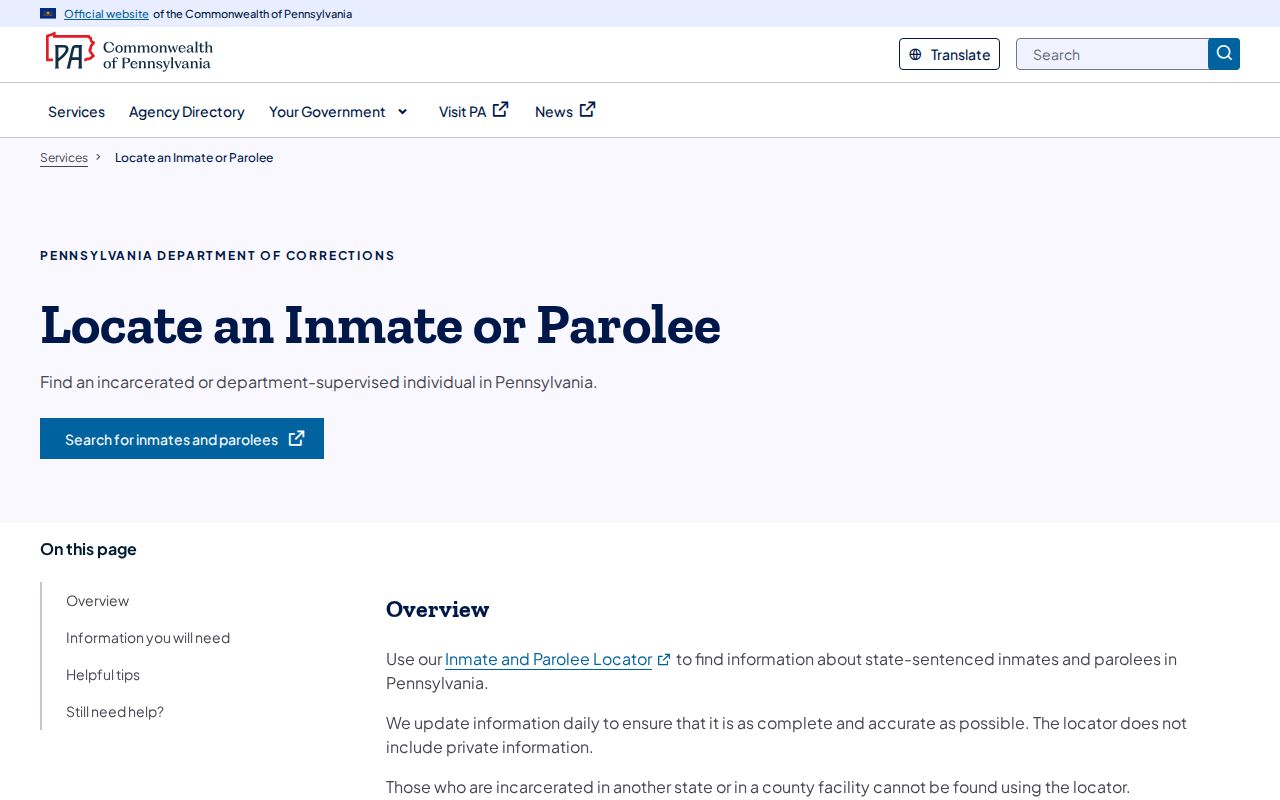
This state tool is useful only when PA DOC custody or parole applies. For the whole named-person path, including county records and court confirmation, use the Lackawanna County released-inmate lookup.
PA DOC Release Date Fields
The state service is formally the Inmate and Parolee Locator. An inmate search accepts last name or inmate number, with first name helpful. Results can include inmate number, name, age or birth information, photograph, current location, and committing county. That proves the scope of a state record, but inspection found no public field labeled Projected Release Date, Tentative Release Date, Minimum Date, or Maximum Date.
The parolee side has a field called “Release Date.” It records a past release to parole. It is not a future forecast. A parolee result may also show a parole number, district office or location, photograph, and absconder indicator. State parole means custody in prison ended while sentence supervision continues.
| Record or date | What it establishes |
|---|---|
| Sentencing order | Imposed minimum and maximum terms, concurrency or consecutiveness, and other court directions. |
| Minimum date | Ordinary parole eligibility point, not automatic release. |
| RRRI minimum | A separate eligibility point for a qualifying person who completes required programming and receives certification. |
| Board Action | The Parole Board's grant, denial, rescission, recalculation, or other decision. |
| Locator Release Date | A past date associated with release to state parole. |
| Discharge entry | Operational proof that a facility ended custody and the recorded disposition. |
Note: Absence from the PA DOC locator may mean county custody, another system, an identity mismatch, or full discharge outside the visible scope.
Pennsylvania Release Date Rules
Pennsylvania does not impose a blanket rule that everyone must serve 85 percent of a sentence. Under 42 Pa.C.S. § 9756, a court generally imposes an indeterminate minimum and maximum, and the minimum ordinarily cannot exceed one-half of the maximum. Under 61 Pa.C.S. § 6137, ordinary parole generally cannot begin before the minimum expires. Reaching that point creates eligibility for consideration, not a right to leave.
- Minimum
- The sentence point when ordinary parole may first be considered, subject to law and Board action.
- Maximum
- The sentence endpoint, subject to lawful recalculation and other custody.
- Parole
- Release from confinement into supervision before the sentence maximum.
- Discharge
- The end of the relevant custody or supervision obligation, as shown by the responsible agency's record.
Life and death sentences are outside ordinary parole eligibility. Consecutive sentences add together, while concurrent sentences run at the same time as ordered. Credit for time served can change the computation. A person with several dockets needs every order reviewed before any estimate is made.
Lackawanna RRRI Release Computation
Recidivism Risk Reduction Incentive, or RRRI, is Pennsylvania's main earned-time-like path. It is not generic “good time.” The sentencing court determines eligibility and directs PA DOC to calculate an RRRI minimum. The official JRI2 and RRRI overview says a qualifying minimum of three years or less is calculated at three-quarters, while a minimum over three years is calculated at five-sixths, with partial days rounded to the nearest day.
Those fractions are 75 percent and about 83.33 percent of the imposed minimum. They are not 85 percent of the maximum. An RRRI minimum still does not guarantee release. Required programming, DOC certification, sentence aggregation, and statutory exclusions apply. One ineligible sentence can make an aggregate sentence ineligible.
The official RRRI page illustrates the program and Short Sentence Parole framework used in a state release-date analysis.
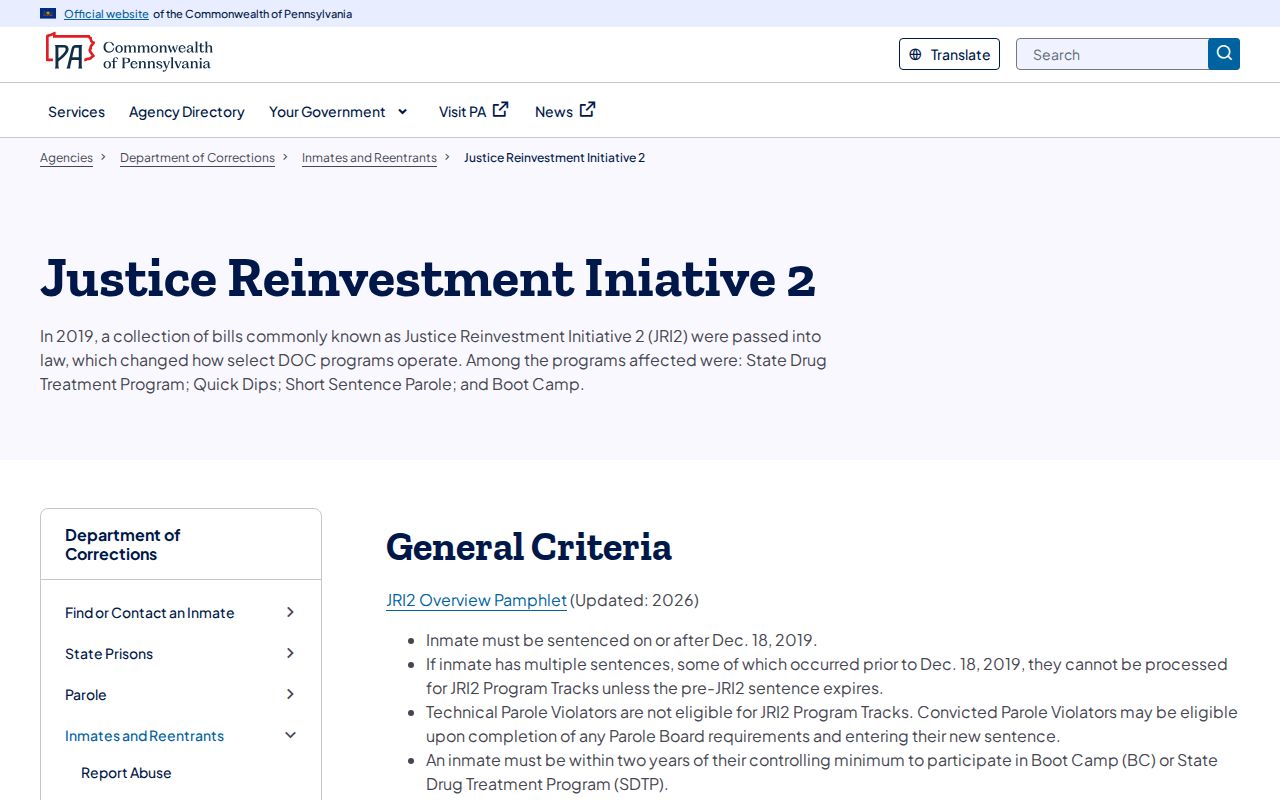
Short Sentence Parole under 61 Pa.C.S. § 6137.1 can apply to qualifying DOC commitments with an aggregate minimum of two years or less, or an RRRI minimum of two years or less, whichever is shorter. Eligibility has exclusions. Major disciplinary infractions, felony detainers or warrants, and Board authority can affect the path. Boot Camp and the State Drug Treatment Program create other completion-based routes for qualifying people.
Why Lackawanna Release Dates Change
A date moves when the lawful inputs or release authority change. The most reliable approach is to ask for the agency's existing computation instead of presenting informal arithmetic as an official date.
| Factor | Possible effect | Record to check |
|---|---|---|
| Amended order or time credit | Moves the minimum, maximum, or county expiration calculation. | Court docket, sentencing order, agency computation |
| Concurrent or consecutive terms | Changes how multiple sentences combine. | Every sentencing order |
| Misconduct or program failure | Can affect a statutory program path or planned parole release. | DOC record and Board Action |
| Detainer, warrant, or new charge | Can prevent community release or cause transfer to another authority. | Docket and receiving-agency record |
| Parole denial or rescission | Ends or delays the expected parole path. | Board Action |
| Administrative processing | Can separate legal authorization from the actual release time. | Facility discharge entry |
A transfer does not mean freedom. Someone leaving Lackawanna County Prison for PA DOC, another county, or federal custody has been released only from the county custodian. The receiving authority must be checked next.
Lackawanna County Sentence Dates
A county case needs local records, not the state locator's sentence framework. For a person at Lackawanna County Prison, read the sentencing docket for the imposed term and credit, then ask the prison or county records office for the existing custody entry. If the person is pretrial, no sentence-derived projection exists at all. Bail can change, charges can be amended, and another case or detainer can keep custody in place after one judge authorizes release.
Lackawanna Local Criminal Rule 525 adds a county-specific detail. Designated prison corrections officers may accept bail when the usual court-office channel is unavailable. The defendant must sign the bail bond before release, and the original bond moves to the court clerk. That signed bond establishes authority for conditional release, while the prison discharge record establishes that processing actually ended. Real-estate bail cannot be posted through that prison route.
Weekend or after-hours bail is therefore possible, but the rule gives no fixed release time. Staff still must verify the bond and check other holds. A predicted hour based only on the court entry would overstate what the record proves. Ask for the actual discharge date and time after the event.
Build a Lackawanna Release Timeline
A practical calculation starts with every case that can affect custody. Record the commitment date, credit for time served, imposed minimum and maximum, and whether each term runs concurrently or consecutively. Next, identify an RRRI finding or other program eligibility written into the sentence. A court order controls the sentence, but PA DOC performs the state time computation and the Parole Board controls ordinary parole authorization.
Keep eligibility and release in separate columns. The ordinary minimum, an RRRI minimum, or a Short Sentence Parole point may make a person eligible under the relevant rule. A Board grant supplies legal parole authority. DOC certification, approved release planning, the absence of a blocking detainer, and facility processing still stand between that authority and physical release. The final state record or county discharge entry supplies the actual event.
Other dockets can change the result. A warrant, new charge, or detainer from another county or agency may cause transfer when the first sentence permits release. An amended order can correct credit or alter a term. Misconduct or failure to complete required programming can affect a special statutory path. Ask the responsible agency for its existing computation after any such change rather than adjusting a prior estimate by hand.
The finished timeline should label each source. Use “court-imposed minimum,” “RRRI minimum,” “Board grant,” “expected processing date,” or “actual release date” only when that source supports the phrase. Pennsylvania's locator may later display a parolee Release Date, but that past field cannot be used to fill a missing future projection. PA SAVIN may announce an event, yet it does not guarantee an exact hour in advance.
Confirm a Lackawanna Release
PA SAVIN can send notice of a covered release, move, or other custody change. It provides an alert, not a guaranteed future time. Registration is most useful before the expected event. The Lackawanna County VINE inmate check explains how to match the person, add contact methods, and acknowledge a phone alert.
For Lackawanna County Prison, the permanent commitment and discharge record is the final local evidence. For PA DOC custody, compare the agency computation, Board Action, locator status, and actual release entry. A signed bail bond or court order supplies legal authority but does not alone prove that the prison finished release processing.
A precise conclusion states the kind of date found. “Minimum reached,” “eligible for RRRI,” “parole granted,” “released to parole,” “transferred,” and “discharged” do not mean the same thing. That wording protects the difference between a projection, legal authority, and the event that actually occurred.